By the Bay: Walking Through 50 Years of Kowloon Bay

Stories Behind Hong Kong and Hang Lung's Firsts
Feature Story | Oct 30, 2026
Image

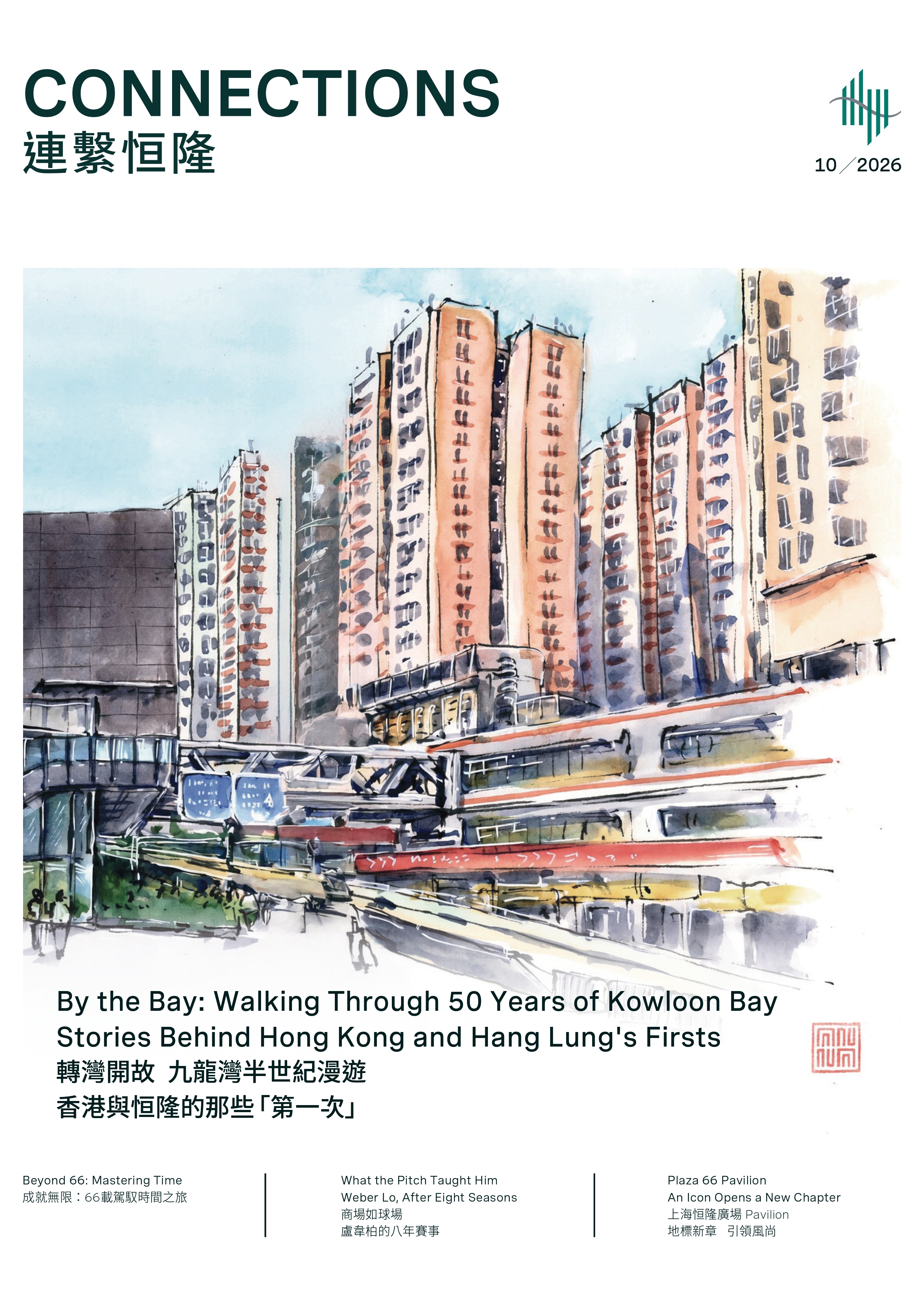
The opening of the new Amoy footbridge in July added a new layer of convenience to everyday life in Kowloon Bay. Connecting Amoy Plaza, the East Kowloon Cultural Centre and Kowloon Bay MTR Station, completing what netizens have dubbed the “Amoy one-minute living circle”. Fully funded, built and managed by Hang Lung Properties, the footbridge does more than shorten the walk for residents. It also links together the story of Kowloon Bay’s transformation over the past half century. From an industrial powerhouse to a vibrant residential community and an emerging cultural landmark, the district's story unfolds at both ends of the bridge.

As one of the highlight activities of Hang Lung’s Nationwide Volunteer Month marking the Company’s 66th anniversary, Hang Lung launched more than 50 guided city tours in September under the theme By the Bay: Walking Through 50 Years of Kowloon Bay. This year also saw the establishment of the Hang Lung Archives, which for the first time has systematically organized five decades of shared memories between the Company and the community. Through historic photographs, archival records and everyday objects, participants are invited to rediscover Kowloon Bay, a neighborhood that, while often out of the spotlight, has undergone monumental shifts and birthed several of Hong Kong’s most remarkable “firsts” over the past 50 years.

Image

Pioneering the “Rail Plus Community” Integrated Development

Kowloon Bay was once a sweeping coastline stretching from Hung Hom to Kwun Tong. The post-war industrial boom brought food factories, shipyards, and metalworks to the area. Subsequent land reclamation and the development of Kwun Tong as a satellite town gradually shaped the community we see today.

Hang Lung's deep connection to Kowloon Bay dates back to 1976 with the development of Telford Gardens. To finance the construction of the MTR, the government allowed the railway corporation to fund its expansion through property development. This led to a landmark partnership between Hang Lung, Hopewell, and the MTR Corporation to build Telford Gardens, Hong Kong’s very first “rail plus property” project, pioneering a development model that remains a cornerstone of the city’s urban planning today.

Telford Gardens did more than reshape the skyline of Kowloon Bay; it altered the trajectory of Hong Kong's urban development. This formerly industrial land was infused with large-scale residential complexes, community facilities, and transport networks, drawing in a new population and catalyzing the district's evolution into a highly livable community.

Image

Early Visions of One-Stop Community Living

A short walk from Telford Gardens to Amoy Gardens reveals another chapter of Kowloon Bay's transformation. In its early years, Hang Lung was engaged not only in property development, but also in essential everyday businesses such as LPG distribution. In 1977, the Company acquired the Amoycan Industrial Centre, gradually redeveloping the factory site into what is now Amoy Gardens and Amoy Plaza. 

When Amoy Plaza opened in 1981, Hang Lung had already envisioned it as a comprehensive, one-stop community. With retail, dining, banking services, and even government offices all in one place, allowing residents to meet their daily needs close to home.

Today, the so-called “Amoy Food Street” is most famous for its culinary delights, but in its early days, it offered much more than dining. Stationery shops, laundries and betting outlets all formed part of the neighborhood mix. It was also home to two cinemas — Amoy Theatre and Good Luck Theatre — located just a stone’s throw apart and able to seat around 800 and 1,000 moviegoers respectively. Kowloon Bay was once one of Hong Kong’s most concentrated cinema districts, home to seven cinemas at its peak and a keen witness to the city's golden era of film.

Image

From Dim Lights to The Aperture

Archival photographs also capture how mall design has evolved over time. More than 40 years ago, lighting in Amoy Plaza was deliberately kept dim, allowing shop signs to stand out. This casts a stark contrast to the bright, uniform illumination we are familiar with today. 

This design approach was closely tied to architectural planning. In earlier years, malls often sought to maximize the non-domestic gross floor area permitted under the Buildings Ordinance by fitting more floors within a limited building height, increasing the number of shop units but resulting in relatively low ceilings. During later refurbishments, brighter lighting was gradually introduced to create a more airy and welcoming atmosphere. 

Yet Amoy’s journey of transformation has also seen moments of profound challenge. Along the Amoy footbridge stands The Aperture, a residential development that occupies a site once known as Block 1 of the Amoycan Industrial Centre. 

In 2016, a level-four fire alarm at a storage facility there claimed the lives of two firefighters, shaking the entire city. Hang Lung promptly established a crisis response center to support the families involved, frontline personnel and the wider community. The site was later redeveloped into The Aperture, incorporating pet-friendly and sustainable design elements to meet the lifestyle aspirations of a new generation. In this way, it too has become part of Kowloon Bay’s ongoing evolution.

Amoy’s 108

When the SARS epidemic struck in 2003, Amoy bore the brunt of the outbreak. At the time, Amoy Gardens and Amoy Plaza employed 215 staff, among whom 108 frontline team members steadfastly remained at their posts, working alongside government anti-epidemic measures and stood in solidarity with the residents, earning them the respectful moniker, the “Amoy’s 108.” 

At the height of the crisis, some staff members chose to stay overnight in the office to minimize the risk of cross-infection with their families. Their unwavering dedication and mutual support helped the community weather its most challenging moments.

Image

Rainbow After the Rain

In the aftermath of the outbreak, foot traffic at Amoy Plaza plummeted. To inject new life into the community, Hang Lung colleagues worked tirelessly to develop new ways to bring people back.

The Company was among the first in Hong Kong to issue epidemic spending vouchers: the Rainbow Vouchers, a rainbow after the rain, meant to give the community hope and life again. Hang Lung put HK$8 million into the scheme, a scale then unknown for a promotion at a single mall.

The Amoy team later set up its own “Creative Task Force” and launched the “Discovery Avenue” program, putting vacant shops to use to support young entrepreneurs. Applicants needed only to submit a proposal for a chance to open a shop at a monthly rent of HK$3,000, inclusive of utilities. From around 100 applications in the first round, 34 businesses were selected. One secondary school graduate successfully launched a business with HK$60,000 in capital. The Company even provided financial backing for its employees to start their businesses, standing alongside these intrapreneurs. Over five years, the program received 683 applications and successfully helped 168 start-ups.

Image

This spirit of innovation continues to thrive at Amoy today. In support of the Housing Authority’s “Well Being · Start-Up 2.0”, Hang Lung offered six months of rent-free support, followed by below-market rent rates and comprehensive support, enabling young start-up PokeCard to open its first physical store.

Having started as an online business, the Pokémon card shop found new life at Amoy. It features a battle area and card-grading and storage services, transforming into a gathering place for enthusiasts and families alike, much like a small community hub. Its owner, Ricky, grew up in Kowloon Bay and has now returned to Amoy to build his business. Watching students stop by after school, he is reminded of his younger self. For him, the shared joy of opening packs and celebrating moments of excitement reflect the kind of human connection that no online experience can replicate.

Image

Welcoming the First Carer Cafés

A stroll through Kowloon Bay today makes one thing clear: the community is ageing, and nowhere is this more visible than at Amoy Plaza. In response to growing needs around elderly care, Hang Lung and Hong Kong Christian Service launched a three-year dementia-friendly program at the mall. Each month, specially trained Hang Lung volunteers provide free screening services for the elderly, ensuring those in need receive timely support.

As part of the program, Hang Lung also introduced a first-of-its-kind “Carer Café” in collaboration with dining tenants including Hee Kee Cart Noodle, Hi Tea Café & Restaurant and Tao Heung, where designated seating is reserved during off-peak hours to provide respite care for elders living with dementia, giving caregivers a much-needed moment to recharge.

The active participation of our tenants has helped foster a more elderly- and caregiver-friendly community, while also adding to the warmth that defines Amoy. During the guided tours, shop staff even volunteered refreshments for participants. Often, it is in heartfelt details that the sense of community is most clearly felt.

Image

Honoring the Past, Shaping the Future

Hang Lung’s community investment is built on three core pillars: Cultural Connection, Inspiring Youth, and Vibrant Wellbeing. Our guided tours, which began by exploring the district's rich history and culture, have engaged over 50 NGOs, schools, and cultural groups, with more than 1,500 participants to date.

Yet the guided tours are just the beginning. Through the Hang Lung Archives, we will continue to collect stories and artifacts that preserve the shared heritage of our Company and the community we serve.

From a bay to modern residential district, from factories to cultural center, Kowloon Bay has charted its course through constant reinvention. Over the past half-century, it has been home to numerous Hong Kong “firsts”. The newly completed Amoy Footbridge connects more than just physical spaces; it bridges the collective memories of generations of Kowloon Bay residents. 

In the space of 90 minutes, we journey through half a century of change. The past has shaped the present, and the future remains full of possibility.

You May Also Like